Introduction
Learning encompasses various experiences and approaches, among which formal and informal learning represent two distinct yet complementary modes. Understanding the difference between formal and informal learning is essential for educators, learners, and policymakers, as it clarifies how knowledge and skills are acquired across diverse contexts. Formal learning typically occurs within structured settings such as schools or training programs, whereas informal learning unfolds spontaneously through everyday activities and interactions. This essay defines and contrasts formal and informal learning, highlighting their unique characteristics, methodologies, outcomes, and roles in comprehensive education.
Defining Formal Learning
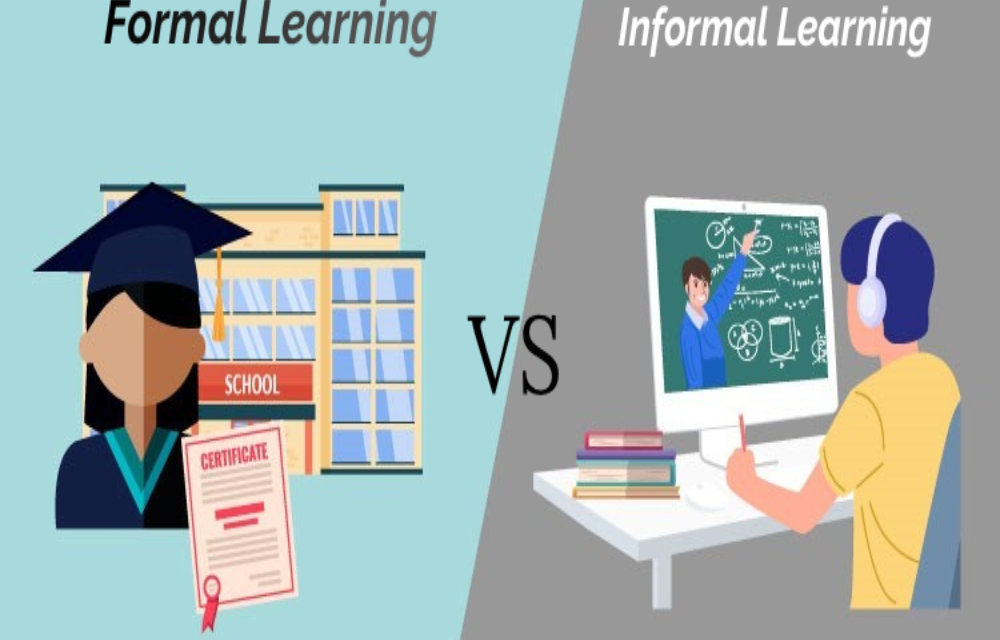
Formal learning refers to education that is systematically designed, organized, and delivered within institutions such as schools, colleges, universities, or training centers. It is characterized by planned curricula, instructor-led teaching, scheduled timeframes, and specific learning objectives. Formal learning often culminates in assessments and certification, providing validation of acquired knowledge and skills. It follows regulatory standards, promoting consistency and measurable outcomes. Formal learning environments employ pedagogical strategies, resource allocations, and evaluation methods structured to ensure comprehensive educational progression.
Defining Informal Learning
In contrast, informal learning occurs outside of formal educational structures and is typically unplanned, spontaneous, and self-directed. It happens naturally through daily life experiences, conversations, observations, problem-solving, social interactions, media consumption, or hobbies. Unlike formal learning, informal learning lacks explicit curricula, instructor oversight, or formal assessments. It is learner-initiated, driven by curiosity, necessity, or interest, and often goes unrecognized formally. Despite its unstructured nature, informal learning significantly contributes to knowledge acquisition, skill development, and personal growth.
Structure and Organization
The primary distinction between formal and informal learning lies in their structure. Formal learning is highly organized, with clearly defined schedules, content sequences, and instructional goals. It emphasizes adherence to a preset educational framework and progression through levels of complexity. Informal learning, however, is flexible and fluid, adapting to the learner’s immediate environment, needs, and pace. It is not bound by time, place, or content constraints, allowing learning to occur anytime and anywhere. This flexibility supports lifelong learning and continuous skill enhancement.
Role of the Educator and Learner Autonomy
Formal learning involves educators, instructors, or trainers who guide, facilitate, and evaluate the learning process. The educator assumes responsibility for designing content, delivering instruction, and assessing performance, with learners following this structured approach. Informal learning places greater autonomy in the hands of the learner, who actively explores, experiments, and reflects without formal guidance. While mentors or peers may influence informal learning, it remains primarily self-directed and individually tailored to the learner’s interests and goals.
Assessment and Certification
In formal learning, progress is measured through standardized assessments, exams, quizzes, or projects that validate achievement and mastery. Successful completion leads to certificates, diplomas, or degrees recognized by institutions and employers. Informal learning, lacking formal evaluation, relies on self-assessment, practical application, or peer feedback to gauge learning. Although informal learning does not usually yield official credentials, it fosters relevant, applied skills that directly impact personal and professional competencies.
Learning Context and Content
Formal learning content is designed to cover theory and practice systematically, often aligned with academic disciplines or professional standards. It is content-rich, comprehensive, and transferrable across contexts. Informal learning is context-specific, experiential, and pragmatic, focusing on solving immediate problems, acquiring practical knowledge, or pursuing personal interests. It encourages creativity and adaptability as learners navigate everyday experiences or challenges, complementing the foundational knowledge gained through formal education.
Complementary Nature of Formal and Informal Learning
Both formal and informal learning contribute uniquely to comprehensive education and personal development. Formal learning provides foundational knowledge, critical thinking skills, and credentials necessary for academic and career advancement. Informal learning enriches this foundation with real-world application, lifelong adaptability, and self-motivation. Effective learning ecosystems recognize and integrate both modes, supporting holistic growth, relevance, and responsiveness to individual learner needs and societal changes.
Conclusion
Formal and informal learning differ fundamentally in structure, intentionality, guidance, assessment, and context, yet each plays an indispensable role in education. Formal learning is structured, curriculum-driven, and instructor-led, delivering measurable outcomes and recognized credentials. Informal learning is spontaneous, self-directed, and flexible, fostering practical skills and lifelong learning attitudes. Together, they create a synergistic educational experience that equips learners with knowledge, adaptability, and competencies essential for success in a complex, rapidly evolving world. Understanding these differences is critical for designing inclusive and effective learning opportunities.
Hashtags
#FormalLearning #InformalLearning #Education #SelfDirectedLearning #CurriculumPlanning #Assessment #LifelongLearning #TeachingStrategies #LearningEnvironments #EducationalTheory #StudentEngagement #LearningAutonomy #KnowledgeAcquisition #SkillDevelopment #TeacherRole #LearningContinuum #UnstructuredLearning #LearningGoals #EducationalSystems #ReflectivePractice #LearningOutcomes #EducationPolicy #PersonalizedLearning #LearningAssessment #CollaborativeLearning