

Introduction
Early numeracy development is a pivotal phase in early childhood education, involving the acquisition of foundational mathematical skills and concepts that prepare children for future academic success and everyday life challenges. Early numeracy encompasses a range of abilities, including number recognition, counting, understanding quantity relationships, pattern identification, spatial awareness, and problem-solving. Developing these skills in early childhood is essential for fostering confidence, logical thinking, and an appreciation for mathematics. This introduction provides a framework for understanding early numeracy’s scope, significance, stages, and ways to support children’s mathematical learning journeys.
Defining Early Numeracy
Early numeracy refers to the foundational mathematical knowledge and skills acquired during infancy, toddlerhood, and preschool years. It includes verbal skills such as rote counting and number naming, and nonverbal skills like recognizing quantities, comparing sets, and understanding spatial relationships. Early numeracy is not limited to formal arithmetic but involves informal, everyday interactions with numbers and math concepts, such as sorting, measuring, and patterning. It establishes the basic language of mathematics that children use to interpret the world and engage in increasingly complex mathematical thinking.
The Significance of Early Numeracy Development
Developing numeracy skills early in life is crucial because it influences children’s academic trajectories across subjects and their practical problem-solving abilities. Early numeracy competence predicts later success in mathematics and reading, highlighting the intertwined nature of language and mathematical cognition. Moreover, numeracy skills empower children to navigate daily situations involving numbers, time, measurement, and money, fostering independence and critical thinking. Early engagement with numbers also builds positive attitudes toward math, reducing anxieties and promoting lifelong learning.
Stages of Early Numeracy Development
Numeracy development progresses through overlapping and interrelated stages. Initially, infants demonstrate basic number sense by differentiating between quantities or noticing changes in sets. Toddlers begin to associate number words with corresponding objects and understand size or quantity differences. Preschoolers develop more sophisticated skills such as one-to-one correspondence, counting in sequence, recognizing numerals, understanding ordinal numbers, and beginning simple addition and subtraction using concrete objects. These stages reflect gradual abstraction from concrete experiences toward symbolic representation and manipulation.
Role of Play and Everyday Activities
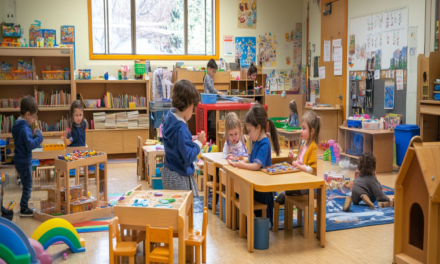
Play and daily routines provide rich, natural contexts for numeracy development. Manipulating blocks, sorting toys, setting tables, cooking, or shopping introduces children to measurement, classification, and estimation. Play-based learning encourages exploration and experimentation with numbers, patterns, and spatial relations in meaningful, enjoyable ways. These activities foster intrinsic motivation and help children apply mathematical concepts to real-world contexts, deepening their understanding and relevance of numeracy skills.
Educator’s Role in Supporting Early Numeracy
Educators have a pivotal role in facilitating early numeracy by creating stimulating environments, modeling mathematical language, and offering targeted activities that promote various numeracy skills. Intentional teaching strategies include using songs, stories, games, and hands-on manipulatives to engage children and scaffold learning. Observing children’s numeracy behaviors informs individualized support, ensuring that learning is developmentally appropriate and meets diverse needs. Educators also foster a positive attitude toward mathematics by making learning supportive and inclusive.
Assessment and Reflection in Early Numeracy
Assessment in early numeracy involves observing children’s abilities and interactions with mathematical concepts in natural and structured settings. Formative assessment helps educators identify strengths, gaps, and misconceptions to tailor instruction effectively. Reflective practice allows teachers to evaluate the effectiveness of their strategies and adapt approaches to better support learners. Regular documentation of progress across numeracy domains supports communication with families and ensures continuity of learning pathways.
Challenges and Equity Considerations
Despite the importance of early numeracy, disparities in access to quality math experiences persist due to socio-economic, linguistic, and cultural factors. Children from marginalized communities may face limited exposure to numeracy-rich environments or suffer from educational inequities. Addressing these challenges requires culturally responsive teaching, family engagement, and policy support to provide equitable opportunities. Prioritizing early numeracy development for all children fosters educational justice and foundational skills critical for lifelong success.
Conclusion
Early numeracy development encompasses fundamental mathematical skills and understanding essential for children’s academic achievement and daily functioning. Its progression through developmental stages reflects increasing abstraction and complexity, supported naturally by play, everyday activities, and intentional teaching. Educators play a central role in fostering positive and inclusive numeracy experiences while ongoing assessment and reflection ensure tailored support. Addressing equity challenges ensures all children benefit from early numeracy opportunities, laying strong foundations for future learning and engagement with mathematics.
Hashtags
#EarlyNumeracy #ChildDevelopment #MathematicalSkills #Counting #NumberSense #PlayBasedLearning #MathematicsInEarlyYears #SpatialAwareness #PatternRecognition #EducatorRole #InclusiveEducation #FormativeAssessment #CognitiveDevelopment #NumeracyStages #ProblemSolving #PositiveAttitudes #NumeracyEquity #EarlyLearning #TeacherSupport #HandsOnLearning #LifelongSkills #MathMotivation #FamilyEngagement #CurriculumDevelopment #EducationalEquity